
The Bank of Canada hiked interest rates by 0.25 per cent on Wednesday to 2.5 per cent, marking the first change to its benchmark in a year and the first increase in three years.
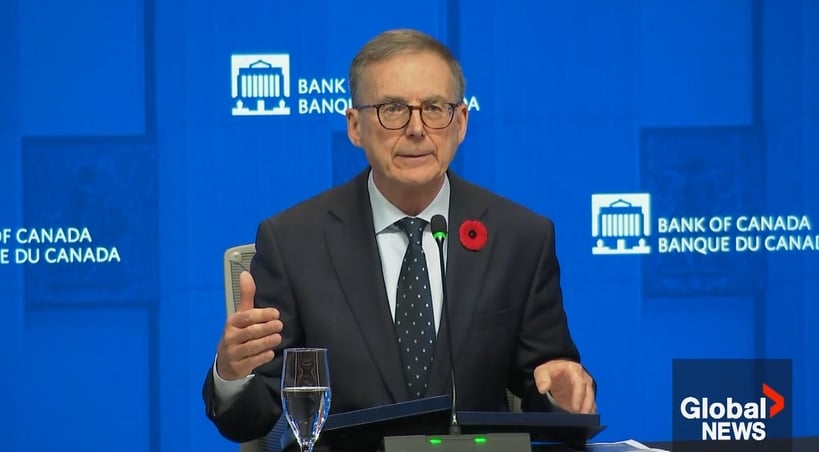
Speaking to reporters Wednesday after the announcement, Bank of Canada Governor Tiff Macklem ackowledged how raising rates will feel for Canadians and businesses, saying “look, we get it.”
“The best thing we can do is that we can get inflation down. We can prevent these higher energy prices from spreading to the prices of other goods and services. And by raising our policy rate today, that’s going to help lean against that pass-through, and it’s going to help get inflation back,” said Macklem.
“Yes, it’s not going to feel good immediately, but that’s how you get inflation back down, and that will feel good for Canadians and Canadian businesses.”
The move was widely expected by most economists as the central bank faces pressure to raise interest rates with the Iran war and other geopolitical conflicts resulting in higher prices for oil and gas, which is expected to lead to higher prices for goods and services beyond the gas pump.
Wednesday’s interest rate hike is what one economist sees as “an insurance policy” against inflation rising in the near future.
“Inflation pressures haven’t eased enough to reassure the Bank, and this move signals it is taking the supply shock seriously, even with the economy running well below full strength,” said principal economist Andrew DiCapua of the Business Data Lab and Canadian Chamber of Commerce in a statement.
“Its decision is predicated on stronger economic growth ahead, and that assumption will be tested, especially with the labour market still showing signs of slack.”
The Bank of Canada said in a statement it expects inflation to rise to about 3.5 per cent by the end of the year, as oil and gas prices push up the headline figure. When stripping away elevated gasoline prices, core measures of inflation have been closer to two per cent — the Bank’s target — but that is expected to change.
“Cost pressures are building, with high fuel prices raising the costs of production and transportation. Imported industrial and electronics input prices have also increased,” the Bank of Canada said in a statement.
“While businesses have mostly absorbed higher input costs so far, Bank surveys suggest cost pass-through will increase over the next year. Near-term household and business inflation expectations have risen, while longer-term inflation expectations remain well anchored.”
The Bank adds that its outlook for inflation is higher than its projections from July.
Financial markets and a Reuters poll of economists were betting that the central bank would deliver a quarter-point hike to its policy rate, the first increase in the key lending rate since July 2023.
“The Bank of Canada raised its overnight rate by 25bp to 2.50 per cent as widely expected today, as it looks to guard against the threat of elevated energy prices becoming a widespread inflationary problem,” said senior economist Andrew Grantham at CIBC in a statement.
The floor for borrowing rates set by the Bank of Canada was at 2.25 per cent since October 2025, when rates were cut from 2.5 per cent.
The Bank of Canada also released its updated forecasts for inflation and economic growth Wednesday, and said higher oil and gas prices are expected to continue accelerating inflation.
“With persistently elevated oil prices and refinery margins, inflation has risen in most countries,” said the Bank of Canada.
“The conflict in the Middle East is now in its eighth month and there is no clear path to resolution. The combination of higher-for-longer energy prices and increased pass-through adds to the persistence of inflation.”
The Bank of Canada said it expects the Canadian economy to grow in total by one per cent this year, and two per cent in 2027 and 2028 respectively, but stressed its forecast is “subject to considerable uncertainty,” especially because of trade tensions between Canada and the U.S.
The central bank also suggested in its statement that more hikes could be on the way.
“Looking ahead, governing council agreed we would take our decisions one meeting at a time. There could be a need to raise the policy rate further, but given the uncertainties, we will proceed carefully,” said the Bank of Canada.
Grantham says the Bank of Canada will likely proceed with caution, holding rates at 2.5 per cent at the December meeting, and hiking again in January by 0.25 per cent.
“We don’t expect that core measures of inflation will accelerate as much as the Bank fears, which should become more obvious early in 2027 and allow the Bank of Canada to then hold interest rates at 2.75 per cent throughout the remainder of next year,” said Grantham.
source & photo: Global News